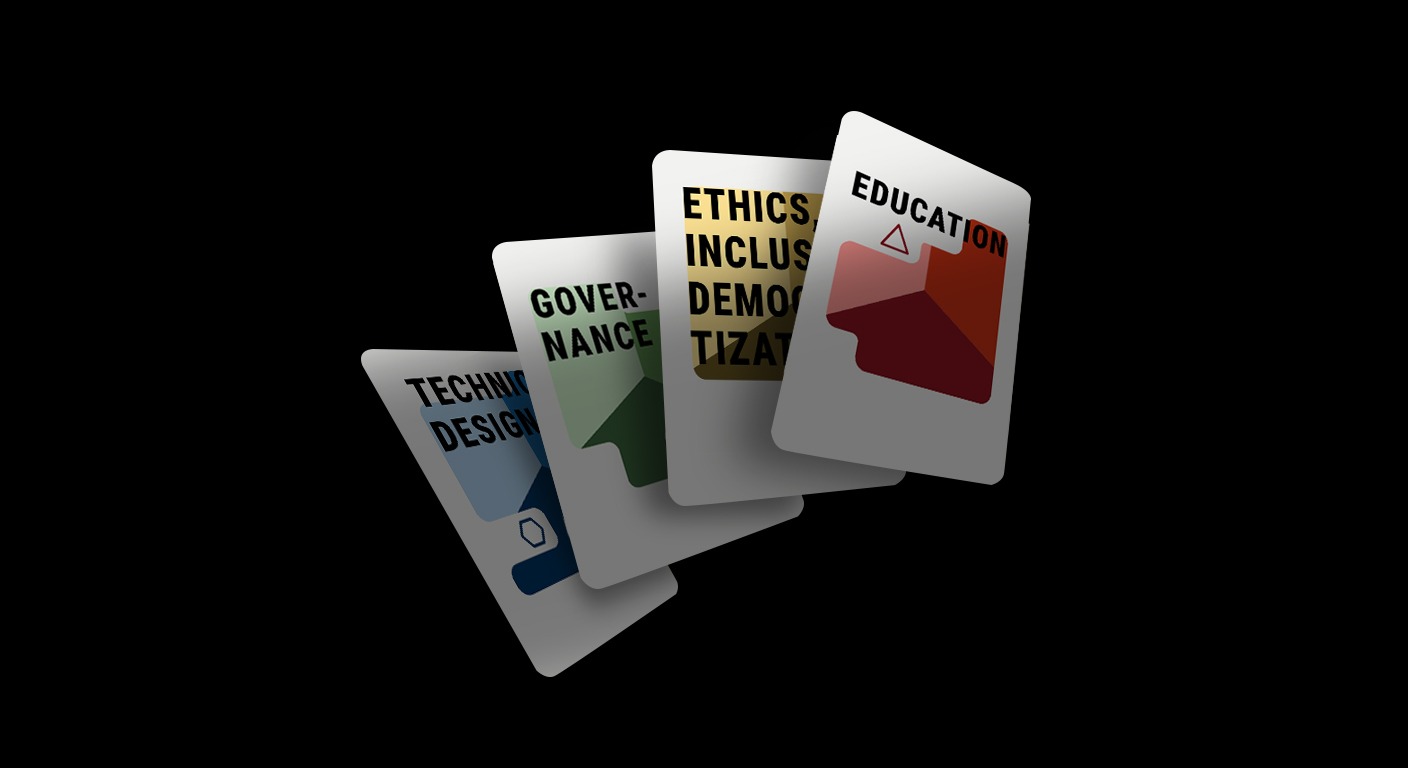
The T4R learning programme consists of accessible, modular, and curatable learning units combined with a train-the-trainer approach. It is designed to support learning and participation in the design and use of LDTs for technical and non-technical users. It integrates systems-design principles with perspectives on ethics, governance, inclusion, and democratization, while promoting hands-on, experience-based learning that encourages reflection, engagement, and practical application. Developed collaboratively through co-creation with project partners and local stakeholders, the programme enables the adaptation of modules to diverse contexts, target groups, and learning needs.
The K8 Training Program on Local Digital Twins
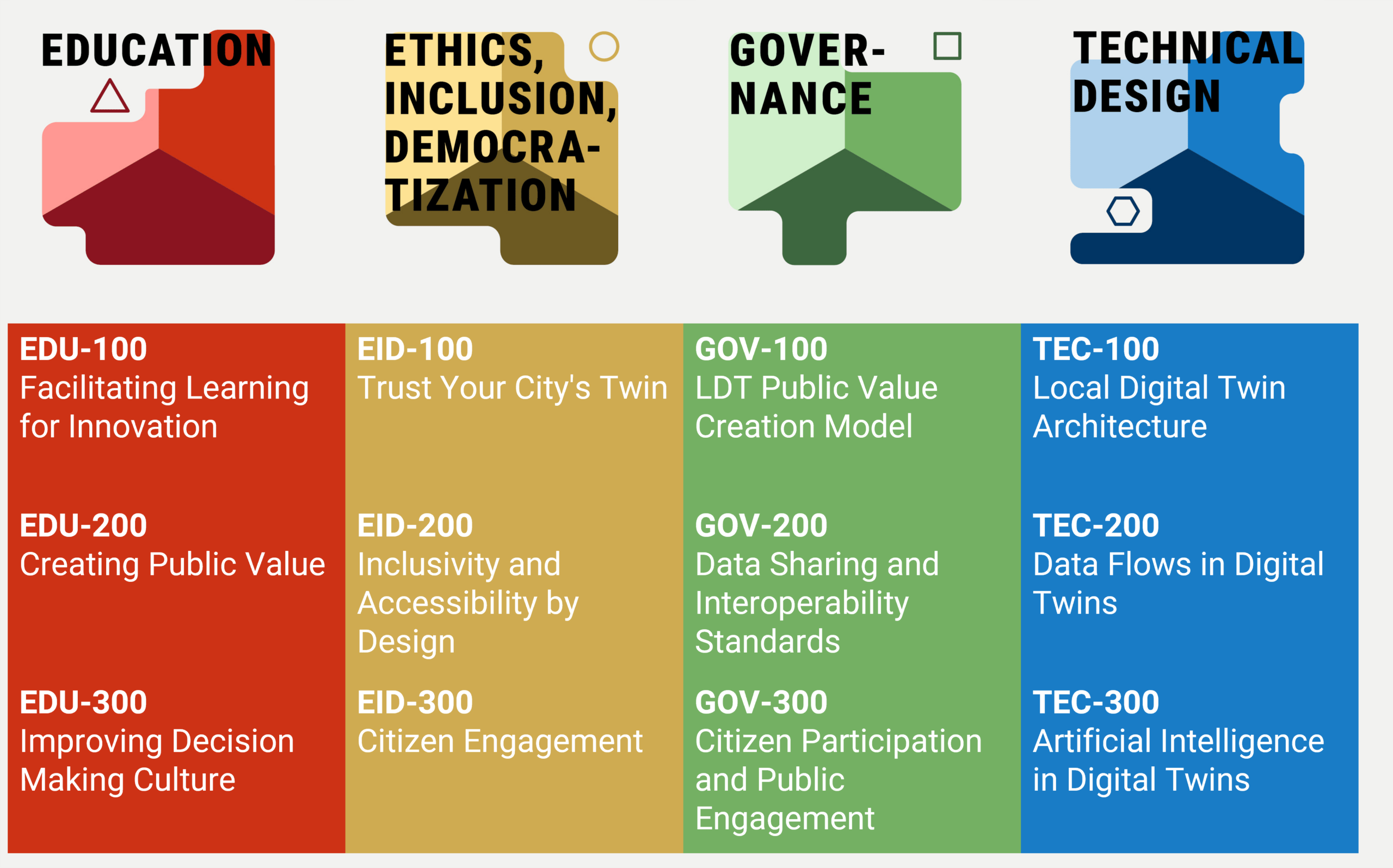

EDUCATION
These MLUs focus on how you can take an active role in system design processes.

ETHICS, INCLUSION, DEMOCRATIZATION
These MLUs focus on how trust can be created among all involved groups.
How to access the material and design your own training
The one stop-shop serves as a guideline for designing your own training curriculum on local digital twins. It wraps all training material and accompanying supporting documents into a single process.
For education managers
Anyone organizing education for their organization is an education manager. It’s not necessarily an actual position, but a role someone fulfills formally or informally. In some communities, these are also called Training Manager, Learning and Development Coordinator or similarly.
An education manager is responsible for aligning training offers with the requirements of the organization. For this, it is crucial that they know the organizational values and objectives before designing a new learning programme on Local Digital Twins.
The starting point is a fundamental question: Why does the organisation want an LDT, and what does it expect to achieve? These decisions are typically made at a strategic or political level. Education managers should research past decisions — both deliberate and implicit, as it will help them identify educational needs. Education managers document this backstory, mapping what has already been done in relation to LDT, and derive a working definition of organisational goals from this evidence base. Crucially, this definition must be validated and agreed upon with the relevant decision-makers to ensure alignment.
Beyond the past, the process also requires a foresight analysis — looking ahead to understand the organisation’s long-term intentions. Will the LDT remain a departmental initiative or grow into an organisation-wide programme? How does it connect to resilience and long-term organisational development? Framing both the historical context and the future vision gives the education manager the full picture needed to design a coherent learning programme. The result of this first step is a clearly defined set of organisational goals, grounded in research and oriented towards the future, which then naturally informs the identification of target learner groups.
In the Twin4Resilience project, some of this research and documentation was conducted as part of writing the Pilot Action Plans.


Once organisational goals are documented, the next step is to identify who needs to be trained. This comes from identifying the use case, which is the specific problem the organisation wishes to solve through the LDT. From this it becomes clear which groups of people are involved, what roles they play, and what skills they require. Target groups should thus be deduced from the operational reality of how the digital twin is actually being used.
It is equally important to recognise that target groups are varied. Within any given group, participants may come with very different levels of prior knowledge — for example, experienced professionals transitioning from other tools, recent graduates just entering the field, or specialists with deep topical expertise but limited technical skills. Training must account for these differences.
Target groups can e.g., be:
- Topical experts who use the LDT as a primary tool for their daily work. This includes e.g., spatial planners or urban designers.
- IT experts and developers who are actively building or maintaining the LDT. Their learning needs tend to be less technical and more focused on societal considerations.
- Management-level users who consult the LDT to gain insights to support data-driven decision-making, rather than operating the LDT directly.
- The general public or citizen groups who access the LDT as a source of information — for example, to understand city council decisions.
Facilitators occupy a pivotal intermediary role between the knowledge content — on Local Digital Twins (LDT) — and the target audiences who need to understand and apply this knowledge. Acting as mediators, they are responsible first for clearly defining the object of knowledge to be transmitted, then for identifying the relevant target groups, select and curate the materials most relevant to their audience, adapting content from the train-the-trainer programme into formats suitable for teaching the specific groups they serve. Facilitators do not need to hold formal responsibility for education within their organisation; rather, their value lies in their position at the interface of content and delivery. They should have an interest in teaching others and be good communicators. In terms of selection, facilitators may be drawn from within the target groups themselves — typically individuals already working with the technical aspects of Local Digital Twins, who deepen their knowledge in neighboring fields and then cascade it to colleagues. Alternatively, they may come from an overarching learning department within the organisation. A third pathway involves procuring external teaching services, in which case the programme’s structure helps organisations specify precisely what training outcomes they expect from an external provider.
Want to do the deep dive? Get acquainted with the backbones of our learning philosophy through the Train-the-Trainer Framework Document.
For facilitators
Facilitators are the intermediaries between course contents and trainees. They are developing material, holding classes and are thus enabling the trainees to learn new skills.
A learning journey is composed of multiple learning units, altogether contributing to the specific training for the required skills identified for each target group. It enables learners to become active members of the local LDT community of practice. Crucially, learning journeys should encourage movement across contexts, combining formats provided locally with those provided by partners and stakeholders elsewhere, fostering a “cross-silo” curiosity that can in turn make co-creation processes more effective and support engagement with the ecosystem.
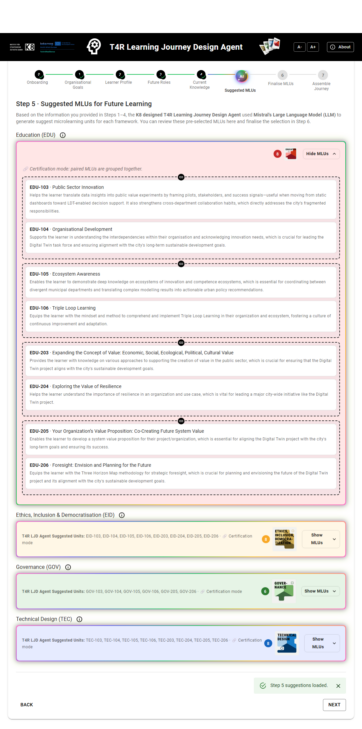
Ready to put all this theory into practice? K8 built a learning journey design agent that guides through the process step by step, and through which you will be able to map target groups, identify required skills, and combine modules and microlearning units for the local context.
The learning journey design agent returns a list of individual microlearning unit content briefs, which can be downloaded from the K8 website. When combined, these comprise the entire learning journey. Each content brief describes the suggested content for this unit. It can then be adapted to form an individual one-hour training session. The microlearning unit content briefs serve as the basis for further training programme preparation!

Localization can relate to translation, however it encompasses much more. The audience may expect material in their local language, or they may need content adapted to their regional context — both are valid starting points. The delivery format matters just as much: if courses are always taught online through a bespoke training platform, the materials need to be designed with that environment in mind, ensuring low barriers and a seamless learning experience. And every Local Digital Twin has its own character — if there is a specific use case, a particular governance structure, or a unique technical quirk that shapes how the LDT works and who works with it, that too needs to be reflected in the localized training. Effective localization means taking the pre-designed microlearning unit content briefs adapting them to local needs and local target groups, so that every learner can connect what they are learning to the concrete realities of their own organisation and context.
Local facilitators are at the heart of the teaching process, delivering the pre-selected microlearning units through a lessons format, and assessing whether trainees meet the requirements to pass. Oftentimes, general activities or teaching methods can be adapted to suit the local expectations. For some microlearning units, K8 even suggests specific activities or teaching styles. These are starting points, not scripts — teaching always has to be adapted to the local style, the local audience, and the specific context of the organisation. The same content may need to be delivered very differently depending on whether working with technically-trained implementers or with managers new to the world of Local Digital Twins, and it is the local facilitator’s expertise and judgment that makes that difference.
Some municipalities already have a certification scheme for their training in place, and wherever possible, we recommend building on what exists. Integrating LDT-specific learning outcomes into established certification processes creates added value for participants as this training becomes part of its broader professional development culture, not a one-off project activity.
Within the Twin4Resilience project, certification is coordinated by project partner All Digital, who issues micro-credentials using the European Digital Credentials for Learning (EDCL) platform. Credentials are issued at each competence level — beginner, intermediate, and advanced — upon completion of the corresponding microlearning unit pairs, giving participants a recognised and portable record of their learning outcomes.
And finally, of course: celebrate your success! Both trainees and organisations have achieved something significant. At the end of the training programmes, each Pilot Partner hosts a festive certificate ceremony. Trainees receive their certificates and are invited to share their experiences. This is also an ideal opportunity to invite members of your Local Stakeholder Groups, colleagues, and other interested parties. Don’t forget to capture these moments with photos or video.